
Is custom software development for your SMB creating efficiency or creating expensive problems? Did you begin with a simple idea to improve operations, which turned into months of delays, rising costs, and endless revisions?
The truth is, custom software development for SMBs often goes wrong, so many businesses assume delays, budget overruns, and scope creep are simply part of the process.
But they do not have to be. This CTO playbook will show you how to avoid common mistakes, reduce risk, and build custom software that delivers long-term value.
Why do so many custom software development projects in SMBs go off track even before the product is fully built?
Here are the most common reasons why most SMBs cannot prevent failures in their custom software development projects.
1. Unclear business goals
Many SMBs start development with broad goals like “improve operations” or “digitize the workflow” without identifying the exact pain points, users, or measurable outcomes. As a result, development loses direction midway.
2. No clear project ownership
When multiple departments keep adding ideas without a single decision-maker, projects become overloaded with unnecessary features, revisions, and delays.
3. Poor requirement planning
SMBs often rush into coding without validating workflows, documenting requirements, or mapping real user behaviour. Small mistakes become expensive technical problems later.
4. Overengineering too early
Instead of solving today’s operational challenges, teams begin building advanced dashboards, automations, scalability layers, and integrations for future scenarios that may never happen.
5. Scope creep expands the project
Features that look “small” create major complexity when combined. Every new addition impacts testing, architecture, integrations, deployment, and maintenance efforts.
6. Wrong technology choices
Trend-driven frameworks and overly complex architectures create long-term maintenance challenges.
7. Integration challenges are underestimated
APIs, legacy systems, and third-party tools often take far more effort to connect properly.
8. Weak testing and QA processes
Limited testing leads to unstable software, performance issues, and security risks after launch.
9. Low user adoption
Complicated systems with poor user experience reduce internal adoption and operational efficiency.
10. No post-launch strategy
Many SMBs fail to plan for ongoing support, updates, scalability, and system optimization.
Overengineering is one of the biggest reasons custom software development projects fail in SMBs. It happens when businesses start building for future assumptions instead of solving current operational problems. As development expands, simple software projects slowly become larger, more expensive, and far more complicated.
For SMBs, this creates serious problems like the following:
Before a single line of code is written, CTOs need clarity on three things: what problem the software actually solves, how success will be measured, and what the business can realistically afford in time, budget, and resources.
Getting this right early is what separates projects that deliver value from ones that drain it. Here’s what experienced CTOs focus on before development begins:
1. Define one core business problem first.
Solve the highest-impact operational issue before layering in secondary features. Clarity on the core problem keeps everything else in check.
2. Set measurable project goals.
Vague goals lead to vague outcomes. Define success in concrete terms such as faster workflows, reduced manual effort, better customer experience, or direct revenue impact.
3. Separate must-haves from nice-to-haves.
Not everything belongs in version one. Prioritize critical functionality for the first release and push everything else to a future roadmap.
4. Build budgets and timelines that reflect reality.
Account for development, testing, deployment, integrations, maintenance, and post-launch support, not just the build phase.
5. Match technical decisions to your current business stage.
Build for where the business is now, not an imagined future. Scalability matters, but overengineering early is one of the fastest ways to blow a budget.
6. Assign clear ownership and decision-making authority.
Ambiguity in leadership creates delays, conflicting priorities, and unchecked scope creep. Someone needs to own every major decision.
A retail startup once reached out to us after burning through 14 months and $80,000 with a previous vendor. They had a beautifully documented system and detailed architecture diagrams, but not a single working feature to show their investors.
We stripped the project back to its core, ran a focused 4-week sprint, and put a functional, testable version in front of real users by week five. No future-focused overengineering. Just the right solution for today.
Could your next project head down the same 14-month road? Easily. Because not every development partner builds for your business reality. Some build impressive proposals. With thousands of custom software development companies in the US, knowing how to choose the right custom software development partner is half the battle.
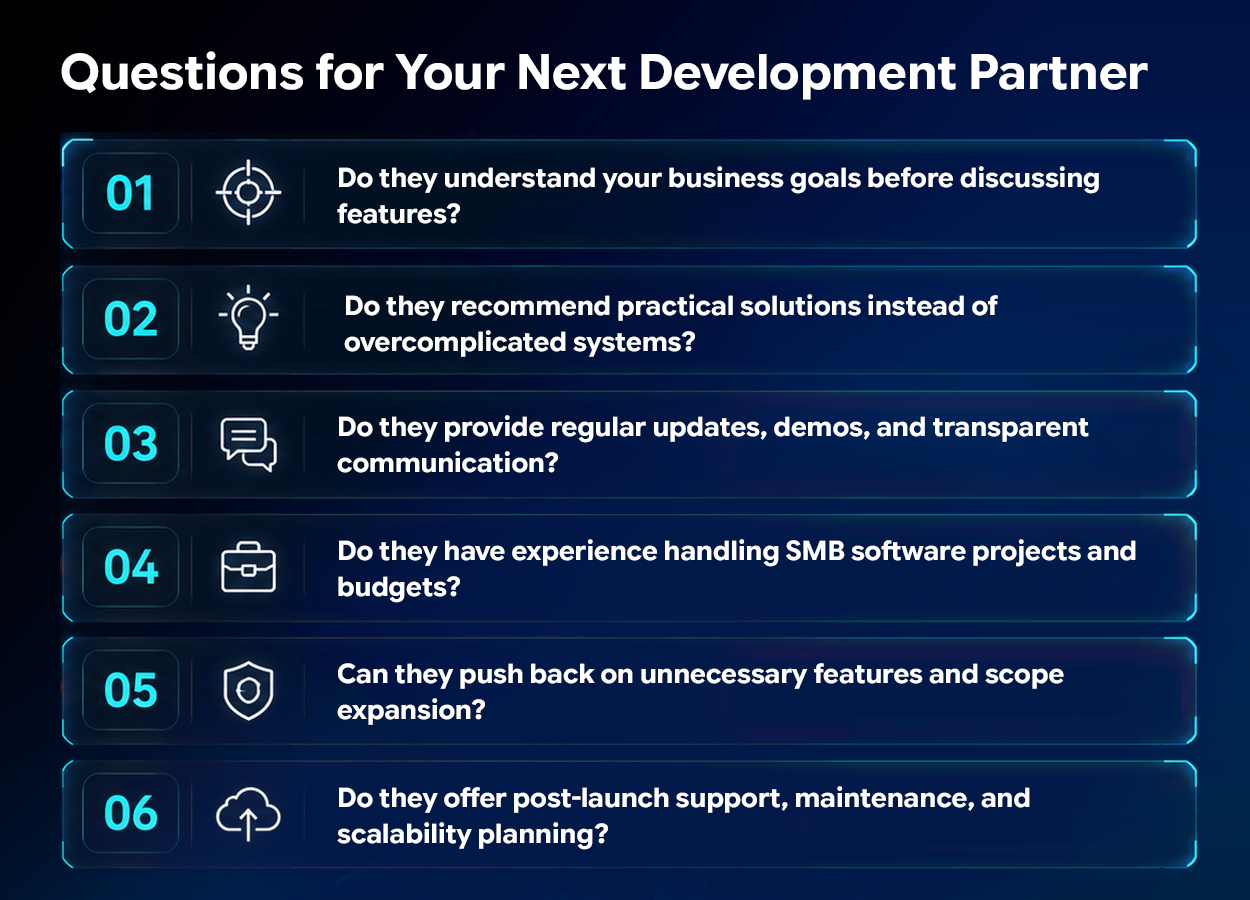
So here’s a set of questions to help you evaluate your next vendor before signing anything:
Scope creep is one of the fastest ways to derail custom software development for SMBs. A few “small” feature additions may seem harmless initially, but they quickly increase development complexity, testing effort, timelines, and long-term maintenance costs.
Most scope creep happens when business goals are unclear, decision-making is fragmented, or new ideas are added without evaluating technical and operational impact.
To keep SMB custom software development under control, CTOs and development teams should focus on the following:
Locking core requirements early: Define the primary workflows, user roles, and must-have features before active development begins.
Running regular demos and review cycles: Frequent feedback helps catch misunderstandings early before they become expensive rebuilds.
Documenting every approved change: Even small feature requests should be tracked for impact on budget, timelines, and architecture.
Keeping communication transparent across teams: Business stakeholders, developers, designers, and QA teams should stay aligned throughout the project lifecycle.
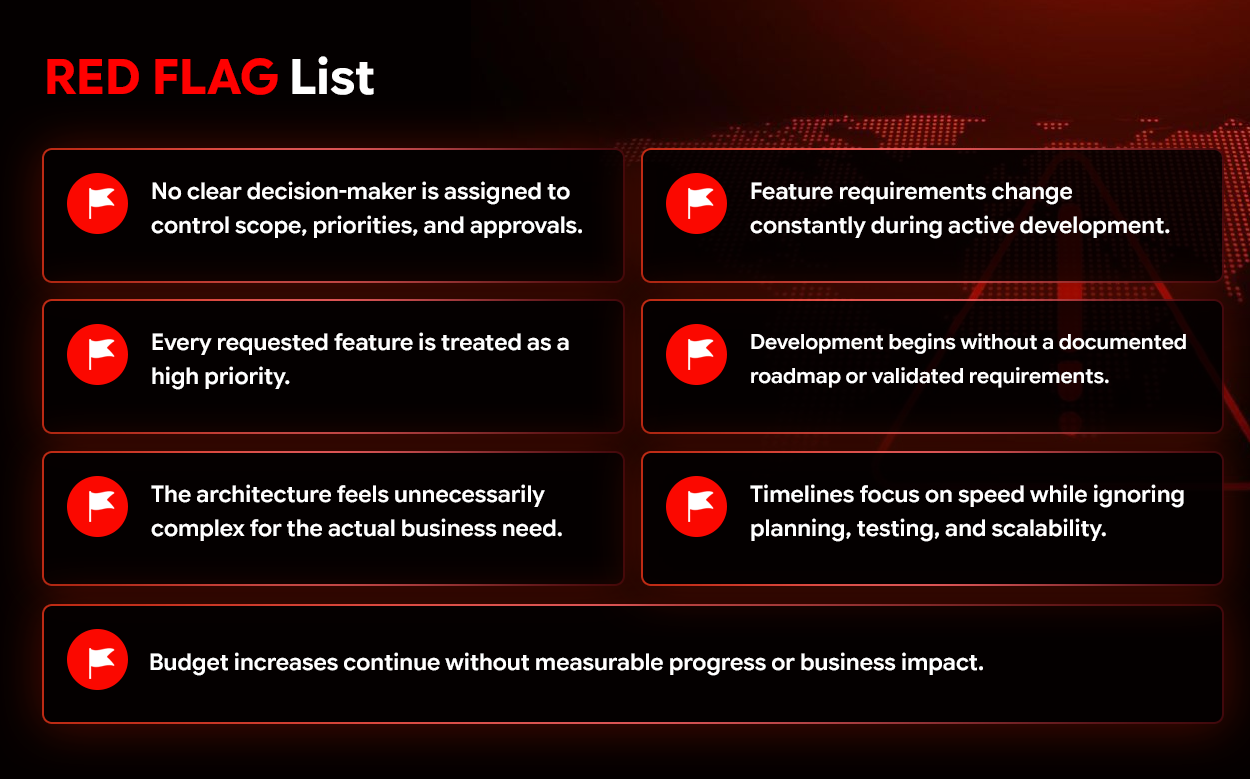
How would SMBs know when a custom software development project is quietly heading toward failure? In most cases, the warning signs appear much earlier than the actual breakdown. Spotting these red flags early can save SMBs from expensive delays, technical debt, and software that never delivers real business value.
Successful custom software development for SMBs is not about building the most advanced platform possible. It is about building software that solves real business problems, stays scalable, and delivers measurable value without unnecessary complexity.
SMBs that focus on clear goals, controlled scope, practical architecture, and strong communication are far more likely to deliver software projects on time, within budget, and with long-term business impact.


